
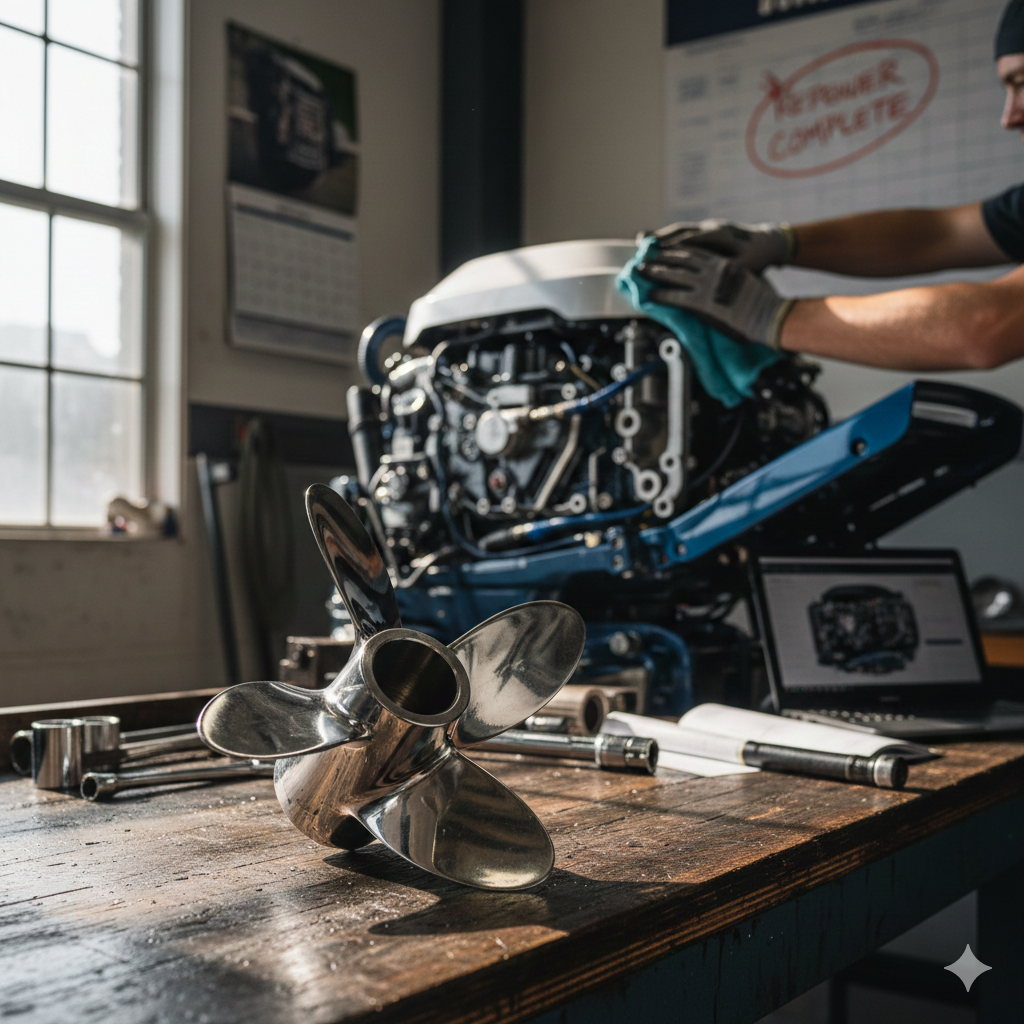
You’ve done it! You’ve upgraded your boat’s engine, giving your vessel a whole new lease on life. The thrill of that fresh horsepower is undeniable, but if you truly want to unlock the potential of your investment—and avoid costly mistakes—there’s one crucial, often-overlooked component you need to address: the propeller.
Repowering your boat with a modern, more powerful, or simply different engine is only half the job. To achieve optimal speed, fuel efficiency, and overall performance, you must match the propeller to your new power source. Think of it as putting the right tires on a sports car—the engine generates the power, but the prop translates it into forward motion.
Why the Old Propeller Won't Cut It
Your boat's original propeller was carefully selected to match the power curve, gear ratio, and maximum RPM of your old engine. Your new engine likely has:
- A different maximum RPM range.
- More or less torque.
- A different gear ratio in the transmission.
Using the old prop on a new engine can lead to serious performance issues and even engine damage.
- Under-propped (Too little pitch/diameter): The engine will easily spin past its recommended maximum RPM (over-revving). This wastes fuel, creates excessive noise and vibration, and can severely stress engine components, leading to premature failure.
- Over-propped (Too much pitch/diameter): The engine will struggle to reach its recommended RPM range at wide-open throttle (WOT). This lugs the engine, preventing it from producing its full horsepower and resulting in poor acceleration, slow top speed, and potential overheating or carbon buildup.
The Key Propeller Variables to Consider
When selecting a new prop, you must find the perfect balance between three primary variables: Diameter, Pitch, and Blade Count.
1. Diameter
The diameter is the width of the circle swept by the propeller blades. Generally, a larger engine (more horsepower and torque) can handle a larger diameter prop.
- Impact: Determines the sheer volume of water the prop can push. Larger diameter is common for heavy displacement boats, while smaller diameter is used for faster, lighter hulls.
2. Pitch (The Most Critical Factor)
Propeller pitch is the theoretical distance (in inches) the propeller would move forward in one complete rotation, assuming there were no slippage in the water.
- Impact: This is your gearing. A higher pitch is like shifting to a higher gear in a car—it provides greater top speed but requires more engine effort and results in slower acceleration. A lower pitch is like a lower gear—it allows the engine to spin up faster (better acceleration) but limits top-end speed.
- Rule of Thumb: Changing the pitch by one inch typically changes the engine's WOT RPM by approximately 150 to 200 RPM in the opposite direction.
3. Blade Count (3, 4, or 5 Blades)
While diameter and pitch are essential, blade count influences the ride quality and specific boat dynamics.
- 3-Blade Props: The most common. Offer a good balance of efficiency, speed, and performance. Often the best choice for all-around recreational boating.
- 4-Blade Props: Excellent for heavier boats, wakeboarding, and stern-drive applications. They often provide better acceleration, better holding power in rough water, and less vibration, but might sacrifice a small amount of top-end speed compared to a 3-blade with similar pitch.
- 5-Blade Props: Used for specific high-performance applications where maximizing grip and minimizing cavitation is key.
The Repowering Performance Checklist
To nail your prop selection, you need to conduct a simple, yet critical, test:
- Consult the Engine Manual: Identify the new engine's recommended maximum WOT RPM range (e.g., 5,000–5,500 RPM). This is your target.
- Start with an Estimated Prop: Use a prop manufacturer's sizing calculator or consult with a marine professional to get a starting prop (e.g., a 15" x 17" pitch).
- Test at WOT: Take the boat out with the test prop and safely run the engine at Wide-Open Throttle (WOT) on a calm day with a typical load.
- Check the Tachometer:
- If your WOT RPM is below the recommended range: You are over-propped. You need to DECREASE the pitch (e.g., drop from 17" to 15" pitch).
- If your WOT RPM is above the recommended range: You are under-propped. You need to INCREASE the pitch (e.g., increase from 17" to 19" pitch).
- Fine-Tune: The goal is to select a prop that allows the engine to operate near the top end of its recommended WOT RPM range. This ensures the engine can hit its peak horsepower while still having a safety margin.
The Bottom Line
Repowering is a significant investment. Don't let a $500 propeller choice choke the performance of your new engine. Taking the time to properly match your prop to your new power ensures that you not only enjoy better acceleration and top speed but also maximize your fuel economy and protect your engine from premature wear.
It's not just about the engine you have; it's about how you use it. Prop selection is the final, essential step to realizing the full potential of your repower project.
Subscribe to our newsletter and receive a selection of cool articles every weeks.
.png)
.png)
.png)
.png)

