
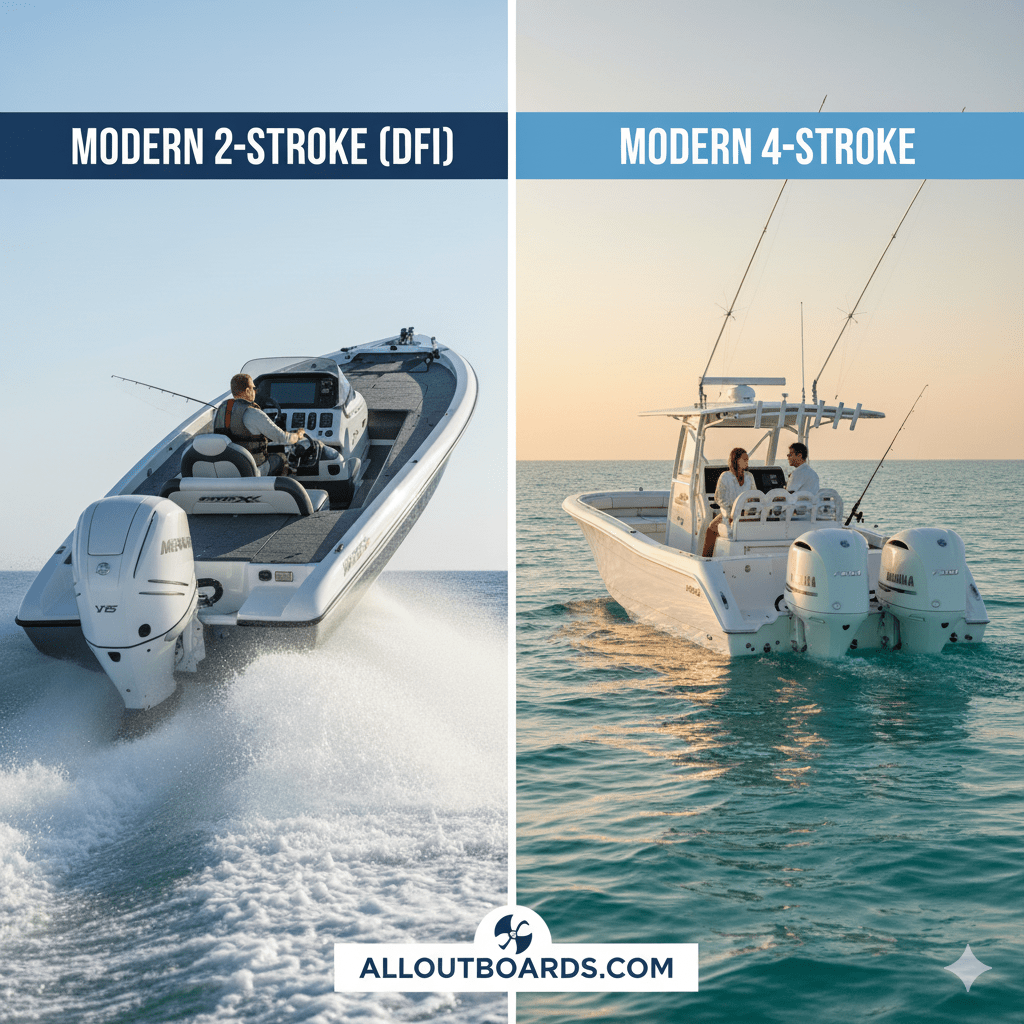
For decades, the debate between 2-stroke and 4-stroke outboards has been the marine equivalent of a heavyweight title fight. However, the generalizations and stereotypes many boaters still cling to are as outdated as a rotary phone. Today's marine technology has fundamentally rewritten the rules.
Forget the smoky, loud, carburetor-fed 2-strokes of the past. Forget the slow, heavy 4-strokes of the early millennium. A modern comparison is essential to choose the right power for your hull. Let's dive deep into the current technology and find out where each design truly stands.
The Modern 4-Stroke: Refined Power
The modern 4-stroke engine has cemented its dominance in many segments, and for good reason. Thanks to advanced engineering, variable valve timing, and sophisticated fuel mapping, today's 4-strokes are powerhouses of efficiency and refinement.
Key Advantages:
- Exceptional Fuel Economy: Modern 4-strokes are incredibly frugal, particularly at cruising and trolling speeds. They maximize every drop of fuel, which translates directly to lower running costs and greater range.
- Acoustic Refinement: They are noticeably quieter, especially at idle, making them perfect for fishing, leisurely cruising, or holding a conversation without shouting.
- No Oil Mixing: Fueling up is simple. No need to carry or mix oil, making the process cleaner and more straightforward.
- Low Emissions: They easily meet the strictest environmental standards, making them a future-proof choice for waters with tight regulations.
However, the technology that delivers this refinement—the complex valvetrain, camshafts, and cylinder heads—also means these engines are often heavier than their 2-stroke counterparts, especially in higher horsepower ranges, and they typically require more involved scheduled maintenance (e.g., oil and filter changes).
The Direct Injection 2-Stroke: The Game Changer
The greatest leap in outboard technology came with the advent of Direct Injection (DI) 2-strokes, like the legacy Evinrude E-TEC and Mercury OptiMax (and current Mercury DFI models). These engines took the traditional 2-stroke design and modernized it, eliminating nearly all of the old drawbacks.
How DI 2-Strokes Changed the Narrative:
- Eliminating Smoke and Pollution: By injecting fuel directly into the combustion chamber just before ignition—rather than relying on a carburetor or old-style fuel injection—DI engines use only the necessary amount of fuel and oil. This results in incredibly clean combustion, virtually eliminating the famous 2-stroke smoke and dramatically reducing emissions to meet modern standards.
- Superior Power-to-Weight: This is the 2-stroke’s enduring superpower. Without a complex valvetrain or heavy oil sump, DI 2-strokes are significantly lighter than comparably powered 4-strokes. This lighter weight translates to better boat performance, especially on smaller, weight-sensitive hulls, as well as faster hole shots and better acceleration.
- Simpler Maintenance: With fewer moving parts and a simpler design, DI 2-strokes typically require less frequent and less involved scheduled maintenance. For example, some designs boast maintenance intervals of up to 300 hours or three years, minimizing time and cost in the service bay.
- Instant Torque: The 2-stroke cycle inherently fires the spark plug with every rotation, giving it exceptional low-end torque and immediate responsiveness—a huge benefit for watersports or quickly getting a heavy hull up on plane.
The Verdict: It's All About the Hull
There is no single "best" motor today; only the best motor for your specific boat and use case.
- Choose the Modern 4-Stroke if: Your priority is the highest possible fuel efficiency, the quietest running experience, and you don't mind the added weight or more frequent oil changes. This is the perfect engine for large pontoons, deep-V offshore boats, and general cruising.
- Choose the DI 2-Stroke if: Your priority is maximum performance, better power-to-weight, superior hole shot, and the simplicity of maintenance. This engine excels on bass boats, bay boats, flats boats, and any smaller hull where minimizing stern weight is critical.
The era of choosing between clean-and-heavy and dirty-and-fast is over. Today, boaters have the luxury of choosing between refined, efficient power and lightweight, immediate torque, both of which meet modern standards for emissions and reliability. The only outdated thing in the water is the boater who hasn't tried both.
Explore all types of outboard motors here at alloutboards.com!
Subscribe to our newsletter and receive a selection of cool articles every weeks.
.png)
.png)
.png)
.png)

